News · Security
National Internal Security Conference opens in Mogadishu without Puntland and Jubaland
Two days of talks on policing, agency coordination and the post-mission security framework proceeded without two federal member states at the table.
News Reporter
Abdi
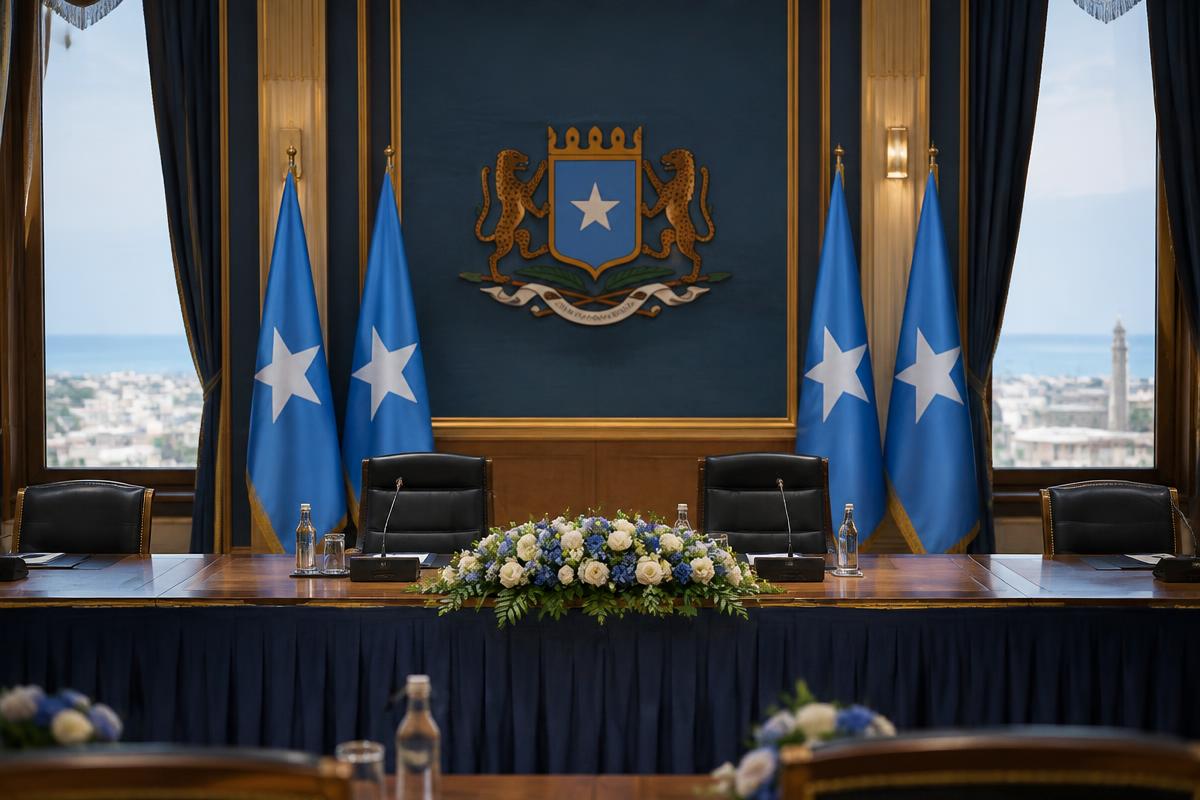
Conference hall in Mogadishu set for national security talks, with empty seats at the table
Two days of national talks on internal security opened in Mogadishu on 1 September, convened by Defence Minister Ahmed Moalim Fiqi and attended by federal security agency heads, police commanders and member-state delegations. The agenda was domestic: policing, coordination between agencies that have overlapping mandates, and the security framework that has to function once the African Union mission has gone.
Two federal member states were absent. Puntland and Jubaland did not send delegations, and Southwest was represented by its interim administration. Whatever the conference agreed, it agreed for a security sector narrower than the country it is meant to cover.
What the agenda actually addressed
The substance of the discussion was institutional rather than operational. Somalia's internal security is delivered by several bodies at once — the Somali Police Force, the National Intelligence and Security Agency, custodial corps and regional police under member-state authority — and the seams between them are where investigations stall, detainees are lost and intelligence is not passed on.
Delegates returned repeatedly to the handover sequence. As African Union contingents vacate forward positions, responsibility falls to police and district administrations rather than to the army, and policing is the part of the security sector with the thinnest payroll, the least equipment and the shortest training pipeline.
Why the empty chairs matter
Puntland has not operated under federal security arrangements it considers invalid, and Jubaland's dispute with Mogadishu remains unresolved. Both administrations command forces, collect revenue and conduct operations. A framework written without them is not a national framework; it is a framework for the territory the federal government administers directly.
That gap has practical consequences for the transition. Benchmark reporting, partner funding and district handovers all assume a single chain of responsibility. Where two chains exist, the handover either stops at an administrative boundary or is negotiated case by case with the administration that is not in the room.
A national security framework agreed without two federal member states describes a security sector narrower than the country.
The conference closed with commitments to coordination structures rather than to a financing plan. The test of those commitments is not the communiqué but the next quarter: whether district police are paid, whether agencies share case files, and whether the two absent states are brought into the arrangements before the mission's positions change hands.