News · Security
Government says it can assume full security responsibility if AU forces withdraw
TUBSAN director general Ali Gurbe dismissed warnings that an AU departure would let Al-Shabaab retake territory, citing trained forces and bilateral security agreements.

News Reporter
Wanjiru
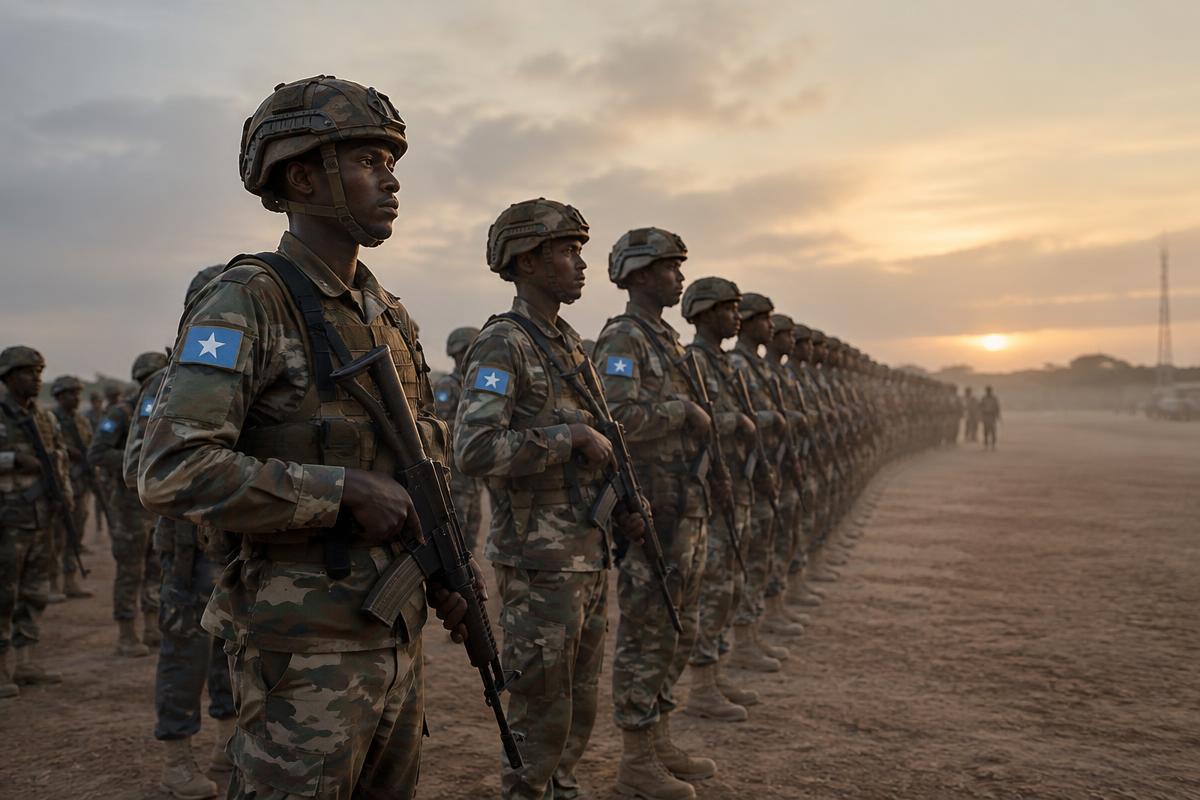
Somali national army troops in formation at a training ground at dawn
Ali Gurbe, director general of TUBSAN, told reporters in Nairobi that Somalia is ready to take full responsibility for its own security, dismissing warnings that an African Union departure would allow Al-Shabaab to retake territory. He cited the forces trained over the past four years and the bilateral security agreements Mogadishu has signed with partners.
The claim is a statement of political intent, and as intent it is credible: Somali units have led offensives in Hirshabelle and Galmudug and held ground that the mission once held. The harder question is administrative rather than martial.
Readiness is a payroll question
What the mission supplies is not mainly infantry. It supplies fuel, rations, transport, engineering, casualty evacuation and the contracted logistics that keep a brigade in the field for months. Those are recurring costs carried on someone's ledger every month, and they do not fall when troop numbers fall.
So the measurable indicators of readiness are unglamorous: whether salaries reach forward districts on time, whether fuel contracts are funded beyond the current quarter, whether medical evacuation is available at night, and whether ammunition resupply is planned rather than improvised.
Bilateral support is real but unpooled
Officials point to bilateral agreements — Turkish, Emirati, Egyptian, American, European — as the substitute for mission enablers. Those relationships deliver training, equipment and in some cases air support. They are not pooled, not commonly commanded, and not obliged to cover a shortfall in another partner's programme.
That shifts the sustainment problem rather than removing it. A force supported by five bilateral programmes has five sets of standards, five reporting cycles and five points of political failure. Consolidating that support into a single national sustainment plan is the work that turns a statement of readiness into a condition.
Mogadishu's position and its partners' warnings can both be accurate. The government is ready to begin assuming responsibility. Whether it is financed to finish is a separate question, and it is answered in budget lines rather than press conferences.
Source
The Eastleigh Voice