News · Security
AUSSOM funding shortfall, not politics, is setting the pace of the drawdown
With the intended UN-assessed backstop never delivered and logistics support ending, the mission's finances are now the operative constraint on transition timelines.
News Reporter
Hodan
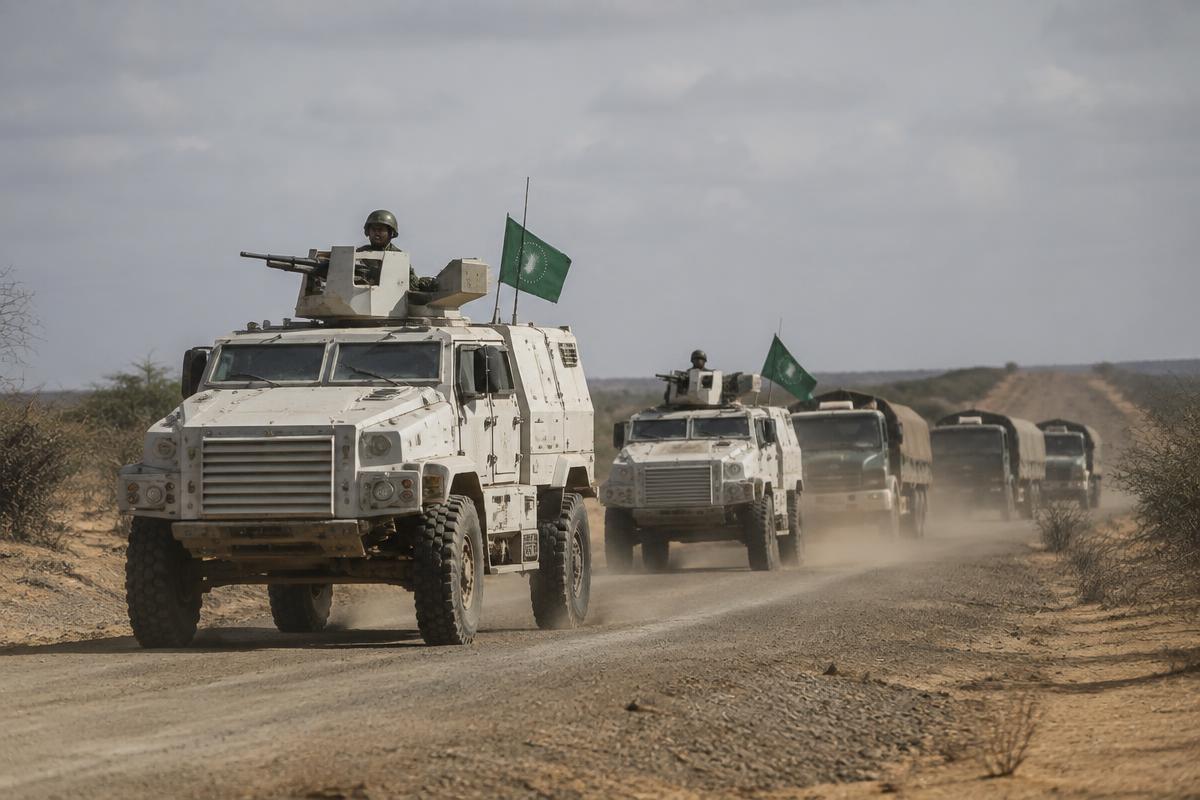
African Union armoured vehicles and logistics trucks on a dirt road in Somalia
The pace of the African Union mission's drawdown in Somalia is now being set by its finances rather than by any political decision. AUSSOM entered 2026 carrying arrears, without the assessed contributions envisaged under Resolution 2719, and a financing event in September produced no substantial new pledges.
The mission's mandate was extended in December 2025 under Resolution 2809. Its funding mechanism was not resolved in the same text, and the gap between those two facts is the story of the transition year.
The expensive half of the mission is leaving first
Public discussion of a drawdown tends to count soldiers. The budget counts enablers. The end of United Nations logistical support removes fuel, rations, transport, engineering and medical provision — the components that allow a deployed battalion to remain deployed.
Those are the costs that neither the African Union nor the federal budget currently absorbs. When they lapse, units do not disappear; they become static, less able to patrol, slower to reinforce, and dependent on whatever local arrangement replaces the contracted supply chain.
What a financing shortfall looks like on the ground
Arrears show up first as unpaid troop allowances in contributing countries, then as deferred maintenance, then as consolidation: several small forward positions folded into one larger base. Consolidation reads as a plan on paper and as abandonment in the district that loses its garrison.
Al-Shabaab reads it the same way. The group has consistently timed pressure to coincide with handovers and repositioning, because a position in transition is a position whose command relationships are temporarily unclear.
The mandate was extended. The funding mechanism was not. The 2026 shortfall was foreseeable from the December text.
For Mogadishu, the implication is that the transition timetable is not fully in its hands. Planning assumptions built on a mission that stays until benchmarks are met need a second version built on a mission that shrinks when money runs out — because that is the version currently in effect.
Source
The Somali Digest