News · Security
Joint AU–government–UN benchmark report sets out the AUSSOM configuration plan
The configuration plan considered by the AU Peace and Security Council ties mission posture to measured progress against jointly agreed benchmarks.

News Reporter
Abdi
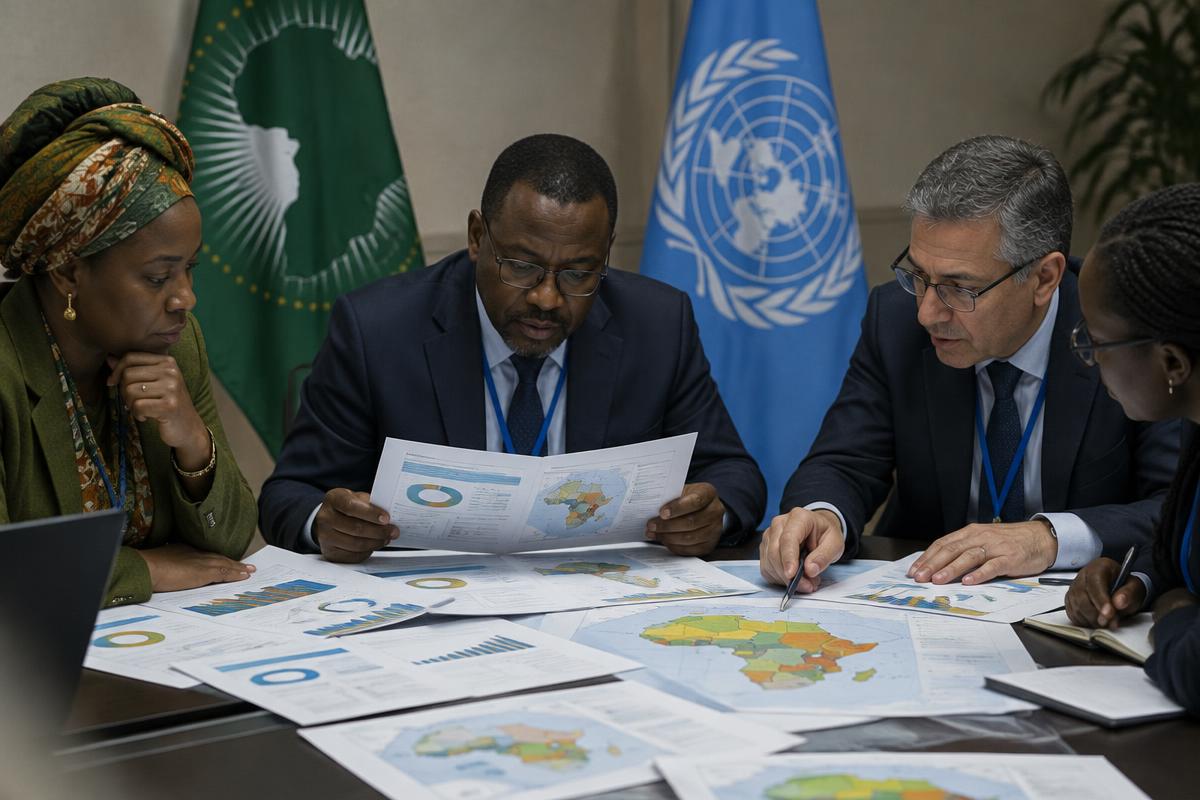
Officials reviewing benchmark reports and maps at a joint African Union and United Nations meeting
A joint African Union, federal government and United Nations progress report considered by the AU Peace and Security Council set out the AUSSOM configuration plan, tying mission posture to measured progress against jointly agreed benchmarks.
Benchmark reporting is the only public instrument that compares claimed capability with assessed capability across the same districts over time. It is the closest thing the transition has to an audit.
What the configuration plan does
It links posture to assessment: where Somali forces are assessed as able to hold, the mission repositions; where they are not, it remains. In principle that prevents handovers driven by political announcement rather than capability.
In practice its usefulness depends on specificity. Aggregated national scores can be read as progress by every party; district-level reporting cannot, and district level is where handovers actually happen.
Benchmarks describe forces, not budgets
This is the plan's structural weakness. A unit can satisfy a readiness benchmark on training, equipment and command and still be unaffordable on the federal ledger once mission logistics lapse. Readiness assessed without a sustainment cost attached will overstate what the state can hold.
Adding a financing column to the benchmark framework — cost per district held, funded through which line, for how many months — would make the configuration plan a transition plan rather than a capability snapshot.