
News · Politics
Egypt Seeks Parliamentary Backing for Military Support to Saudi Arabia
Egypt’s parliament was convening for an emergency session on Sunday after President Abdel Fattah el-Sisi sought authorization to provide defensive military assistance to Saudi Arabia, as Houthi attacks on the kingdom deepen concerns over regional security and Red Sea trade.

News Reporter
Fadumo
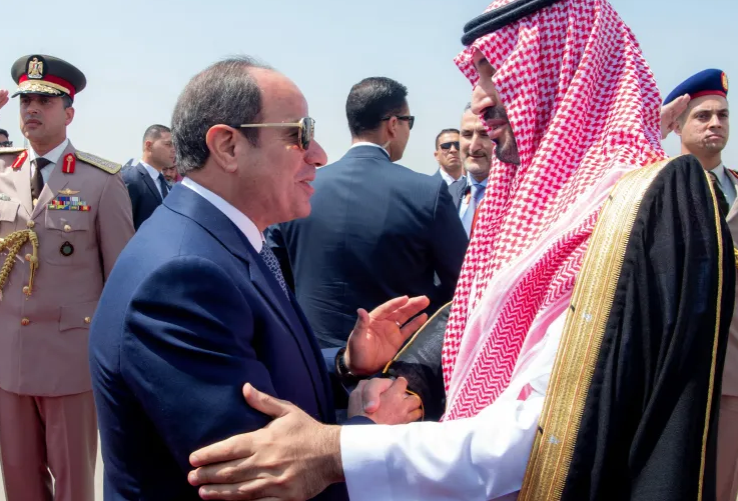
Egyptian President Abdel Fattah wl-Sisi meets Saudi Crown Prince Mohammed bin Salman in Cairo, Egypt on September 15, 2026 [Bandar Algaloud/Saudi Royal Court/Reuters]
Egypt’s parliament was convening for an emergency session on Sunday after President Abdel Fattah el-Sisi sought authorization to provide defensive military assistance to Saudi Arabia, as Houthi attacks on the kingdom deepen concerns over regional security and Red Sea trade.
The proposed authorization would allow Cairo to respond if Riyadh requests support against Yemen’s Iran-backed armed group. Recent attacks have targeted the Saudi capital, airports, and oil facilities, placing pressure on the kingdom’s defenses and raising the stakes for neighboring countries.
Speaking on Saturday, el-Sisi said Egypt would “carry out any measure to protect” Saudi Arabia, while expressing hope that parliament would approve his request. His remarks signalled a willingness to translate Cairo’s longstanding political support for Riyadh into possible military assistance.
Egypt’s presidency also said Cairo would pursue diplomatic efforts to reduce tensions. The National Defence Council, chaired by el-Sisi, pledged on Sunday to provide “all necessary and possible support to Saudi Arabia to defend its safety and stability." It also affirmed support for protecting Saudi territory, national resources, and Islamic holy sites.
The scope of any Egyptian military contribution remains unclear. The statements supplied no operational details, deployment timetable, or indication of which forces might participate. Parliamentary authorization would establish political backing for assistance but would not itself explain how that support would be delivered.
For Cairo, the confrontation carries economic consequences alongside its security implications. Saudi Arabia is a major strategic partner, while disruptions to shipping through the Red Sea threaten traffic through Egypt’s Suez Canal, an important source of foreign currency.
Thomas Bonnie James, a political analyst and Gulf studies expert, told Al Jazeera that Houthi pressure around the Bab al-Mandeb strait was among the converging pressures behind Egypt’s decision. He cited Egypt’s foreign minister as saying the canal had lost about $11 billion since attacks began in 2023.
The safety of Egyptians living in Saudi Arabia adds another concern. James said millions of Egyptians live and work in the kingdom, which he described as Egypt’s largest single source of remittances. An Egyptian resident was killed and others were injured in attacks on Riyadh’s airport, he said.
Regional diplomacy is also shaping Cairo’s calculations. James argued that Egypt would not want to appear absent while other Saudi partners offered protection. Türkiye and Pakistan have made pledges following the activation of collective deterrence measures under the Mecca defense pact signed in August.
El-Sisi had already described Saudi security as integral to Egypt’s national security during talks last month. The emergency parliamentary session now places that commitment before lawmakers, with the extent of any Egyptian role dependent on Saudi requests and the assistance Cairo ultimately agrees to provide.
The immediate question is how that pledge becomes operational.