
News · Politics
The Road to a Secure Red Sea Runs Through Somalia
Houthi Advance Reshapes the Red Sea and Raises the Stakes for Africa

News Reporter
Wanjiru
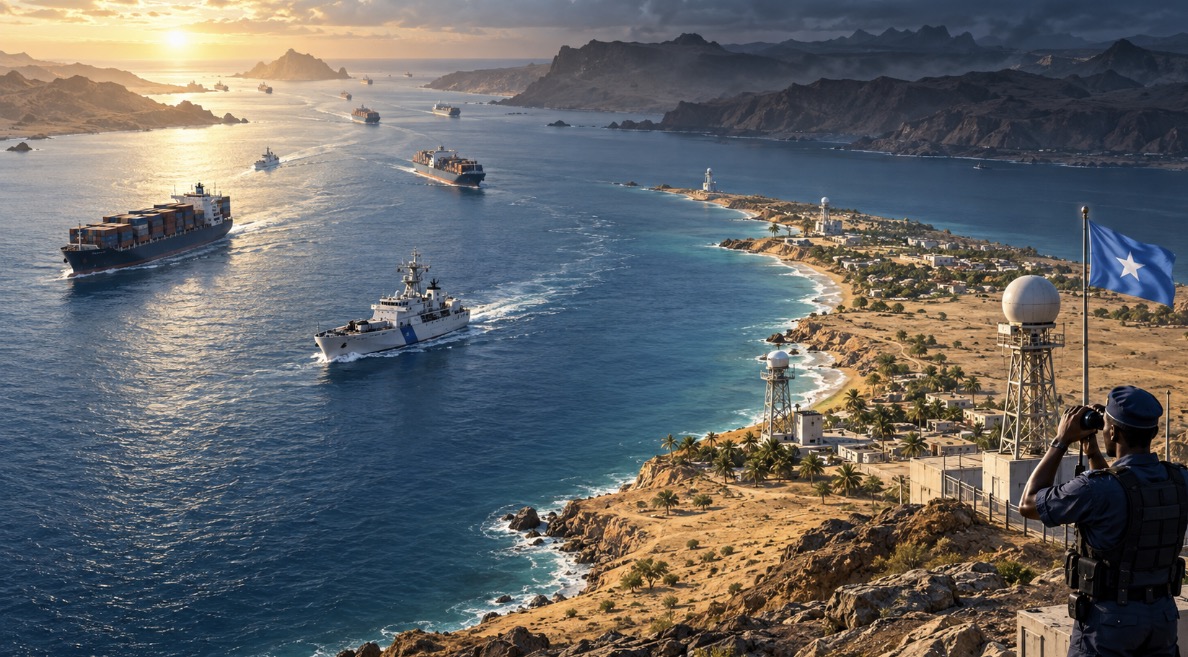
The Houthi takeover of strategic territory near the Bab el-Mandeb Strait has changed the balance of power in one of the world’s most important shipping corridors and pushed the Red Sea crisis closer to Africa.
During their September 2026 advance, the Iran-aligned armed group seized the port of Mocha, Mayyun Island, and the Zuqar and Hanish archipelago from forces aligned with Yemen’s internationally recognized government. The new positions give the Houthis an extended platform along the eastern side of the Red Sea and strengthen their ability to threaten commercial and military vessels.
The Bab el-Mandeb Strait is only about 32 kilometers wide at its narrowest point. It separates the Arabian Peninsula from the Horn of Africa and connects the Red Sea with the Gulf of Aden and the Indian Ocean. Ships traveling between Europe and Asia pass through the strait before entering or leaving the Suez Canal.
Mayyun Island sits directly inside that passage and divides the shipping lanes. Historically, about 12 percent of global trade has moved through the wider Red Sea route. Control of territory around the strait therefore carries consequences far beyond Yemen.
The Houthis have not taken territory on the African side. Their advance, however, makes that shoreline more valuable to governments seeking to monitor, contain or outflank the group. Djibouti, Eritrea, Somalia and Sudan now face greater foreign competition for military access and political influence.
The immediate danger comes from the Houthis’ ability to deploy missiles, naval mines, drones and fast-attack craft along a wider stretch of Yemen’s coast. Iran, the group’s main foreign supporter, also retains the capacity to disrupt traffic through the Strait of Hormuz. A coordinated or simultaneous crisis at Hormuz and Bab el-Mandeb could place two of the world’s most important maritime chokepoints under threat at the same time.
Even the possibility of attack carries a heavy cost. Operators may reroute vessels around the Cape of Good Hope, adding time, fuel and insurance charges. Those costs reach African economies through higher import prices, reduced port income and delayed food shipments.
Egypt faces the largest direct financial risk
Egypt has the most to lose immediately because the Suez Canal depends on the safe movement of ships through the Red Sea. Houthi attacks on commercial vessels and the resulting diversion of traffic cost Cairo an estimated $7 billion in canal revenue in 2024.
Suez Canal revenue recovered to $4.67 billion in the 2025-26 fiscal year, an increase of 23 percent from the previous year. That improvement could quickly reverse if shipping companies again decide that the Red Sea route is too dangerous.
Egypt also depends on the canal for foreign currency and views the Red Sea as part of its national security environment. A stronger Houthi position gives Cairo another reason to deepen cooperation with African coastal states.
Djibouti, Ethiopia and Eritrea come under pressure
Djibouti faces both a humanitarian burden and a strategic test. More than 2,000 people fleeing fighting in western Yemen have crossed to its northern shores. The renewed conflict has displaced nearly 94,000 people since the escalation began in early September 2026.
Djibouti already hosts several foreign military bases. A prolonged confrontation could bring more refugees and greater demands from powers seeking surveillance and naval access.
The danger extends inland to Ethiopia, which conducts approximately 95 percent of its external trade through Djibouti. Disruption affecting the port or the links between the countries could raise prices and restrict essential goods.
Eritrea’s long coastline makes it attractive to Saudi Arabia and Egypt, which want to limit Iranian and Houthi influence on the African shore. Eritrea can use that interest to strengthen its position, but it risks becoming entangled in a wider confrontation.
Somalia and Sudan face overlapping conflicts
The Houthi advance comes as Somalia and Sudan are already struggling with armed conflict and fragile institutions.
A stable and unified Somalia is one of the most important paths toward defeating the Houthi threat in the Red Sea. Somalia occupies the longest coastline along the African side of the Gulf of Aden and sits opposite Yemen. A government that exercises full authority over its territory and waters can deny the Houthis access to smuggling routes, prevent armed groups from using Somali shores and provide regional partners with reliable maritime intelligence. Weakening Somalia would leave a security vacuum along the very corridor that outside powers say they want to protect.
Israel’s violation of Somalia’s sovereignty, including its recognition of Somaliland, risks making that danger more serious. Supporting the fragmentation of Somalia could inflame local disputes, draw competing foreign powers deeper into the Horn of Africa and weaken the federal government’s ability to secure the coast. That instability would create more room for the Houthis and their allies to expand their influence across the Red Sea. Any serious strategy to contain the Houthis must therefore begin with respect for Somalia’s unity, sovereignty and territorial integrity.
The same Red Sea contest is visible in Sudan. Iran has provided support to elements of the Sudanese Armed Forces, which are fighting the United Arab Emirates-backed Rapid Support Forces. By mid-2024, the Houthis had reportedly begun assisting Iran’s efforts to supply weapons to the Sudanese army. The United States Treasury later sanctioned key Sudanese figures over connections to Iran.
Africa’s Red Sea shore is no longer merely exposed to the conflict. Parts of it are becoming supply routes, staging grounds and bargaining tools.
Rival alliances take shape
The geopolitical struggle began before the latest Houthi offensive. In January 2024, Ethiopia signed a memorandum of understanding with Somaliland, the breakaway region of Somalia, seeking access to the coast and a naval base in exchange for a path toward recognition.
Somalia rejected the agreement as a violation of its sovereignty and territorial integrity. Egypt and Eritrea also opposed it. Within a year, the three countries had formed a joint security mechanism, bringing Ethiopia’s maritime ambitions into a broader regional rivalry.
Security cooperation accelerated again in July 2026, when Saudi Arabia hosted talks that produced the Multinational Maritime Defence Alliance. Fourteen countries, including Egypt, Djibouti, Sudan and Somalia, joined the initiative.
The UAE and Ethiopia were excluded. Abu Dhabi’s clashes with Saudi-backed forces in Yemen in December 2025 had already exposed widening differences between the two Gulf powers. Ethiopia’s exclusion reflected its growing alignment with a competing group involving the UAE and Israel.
That alignment became more visible after Israel recognized Somaliland in December 2025. Somalia, Turkey, Egypt and Saudi Arabia now stand on the other side of an increasingly clear regional divide. Iran is also seeking greater military influence along the Red Sea corridor, including in Sudan. Eritrea, meanwhile, is using its coastline to gain leverage and counterbalance Ethiopia.
This is not a simple contest between the Houthis and their opponents. It involves African governments, Gulf powers, Iran, Israel and Turkey, each pursuing its own interests and partnerships.
African states need a common maritime strategy
No African country can secure Bab el-Mandeb alone. The response must include regional coordination, diversified port access and alternative inland routes. Ethiopia’s dependence on Djibouti shows the need for contingency plans.
African governments also need the practical capacity to patrol their waters and prosecute maritime crimes. In August 2026, signatories to the Djibouti Code of Conduct and its expanded Jeddah Amendment agreed to establish a combined task force against piracy.
Its success will depend on ships, intelligence, trained personnel and clear legal authority. States must agree on sharing information, conducting joint operations and prosecuting suspects.
The latest Houthi advance has increased the strategic value of Africa’s Red Sea coastline. That gives coastal states diplomatic leverage, but it also makes them targets for pressure from competing foreign powers.
African governments do not yet control the wider Red Sea agenda. They can still shape it by acting together, protecting their ports and refusing to let outside rivalries dictate their security choices. The central challenge is to use the continent’s geography as a source of collective influence without allowing the African shore to become another front in a Middle Eastern war.